
Maryland Voter Lookup Fields
The Maryland Voter Lookup is a free, current-record service run by the State Board of Elections. It is designed for a voter checking a personal record, not for broad research on other residents. Every required value must agree with the registration. No account or fee is needed, but the combined identity and address fields, along with automated-access controls, keep the tool from working as a browseable voter directory.
| Lookup field | Input | Required | Maryland format |
|---|---|---|---|
| First name | Text | Yes | Up to 30 characters; use the registered name |
| Last name | Text | Yes | Up to 30 characters |
| Date of birth | Month, day, year | Yes | MM, DD, and four-digit YYYY |
| ZIP code | Text/autocomplete | Yes | Five digits |
| Street number | Text/autocomplete | Yes | House number only, up to 10 characters |
| Middle initial | Text/autocomplete | No | One character |
Enter the name used when registering, then supply the date of birth, ZIP code, and house number. The portal also links to registration, voter updates, mail-in ballot requests, and polling-place tools. If the address or name changed, use the update service or call the proper local board. This fallback is part of the record-check process, not evidence that a missing result means no record exists.
The official Maryland search screen shows the exact-match controls used for this check.
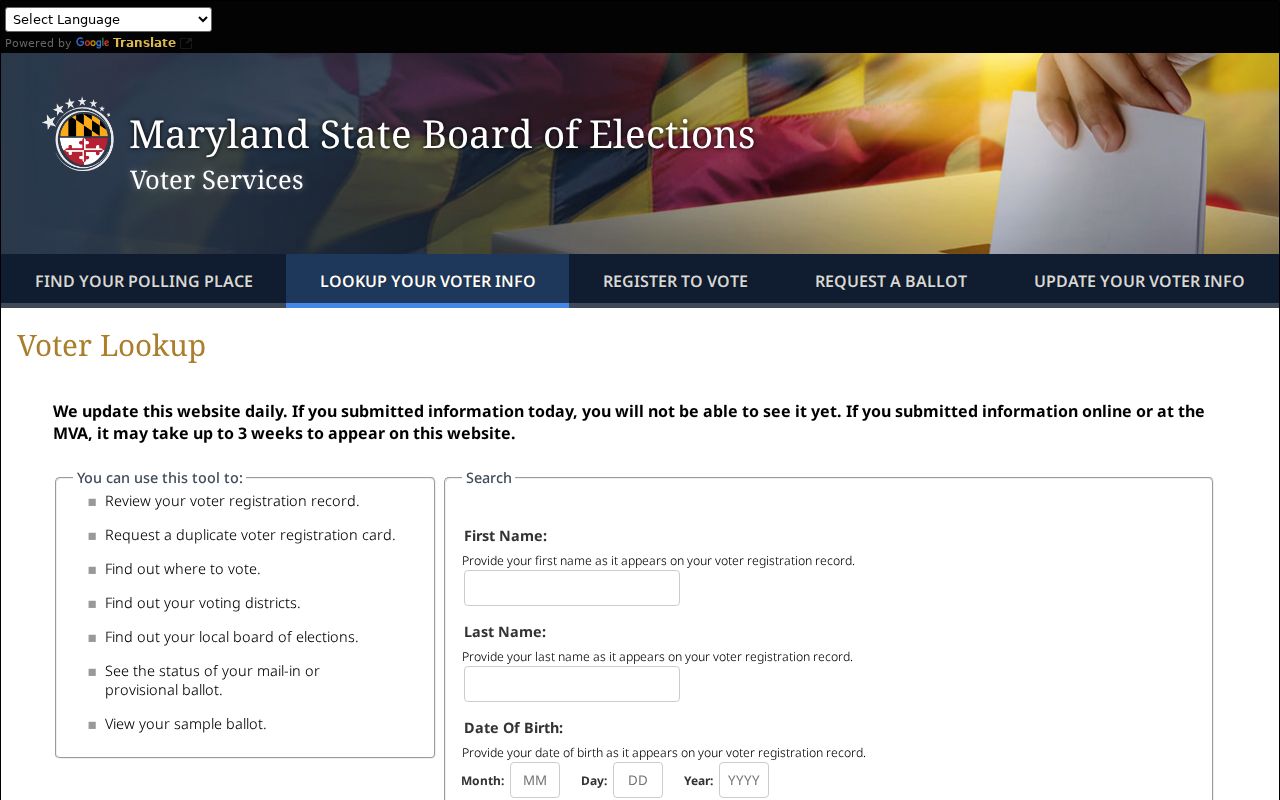
The screen reinforces that ZIP code and street number are separate required inputs rather than a full street-address search.
When Maryland Lookup Finds Nothing
A no-match response can come from an old ZIP code, a former name, a middle-initial difference, or the exact spelling held in the registration record. Try only known variants. Do not guess private facts about another person. The State Board says voters who have not received an updated Voter Notification Card within three weeks should verify online or contact their local board, so recent updates can also warrant a direct check.
This is a useful myth to retire: an exact-match failure does not prove a person never registered. Maryland’s system asks for several matching facts precisely because it is self-service. Call the local office, describe the change, and ask what lawful proof or update step is needed.
Exact-match tip. Check the ZIP and street number from the registration address before changing the spelling of the voter’s name.
What Maryland Voter Records Hold
Maryland election records maintain more information than the self-lookup necessarily displays. Election Law §§3-501, 3-505, and 3-506 govern the record and access paths. A successful personal lookup is meant to return registration and election information, including polling details. Purchased extracts can include fields chosen for an authorized electoral use, but their layout depends on the product ordered.
| Voter name | Identifies the registrant; the self-lookup also requires other matching facts. |
|---|---|
| Address | Residence assigns precinct and districts; a different mailing address may also be maintained. |
| Party and status | Party affiliation and active or inactive status may appear in election data. |
| Registration date | Maintained and available depending on the extract definition. |
| Districts | Congressional, legislative, county or council, and other districts derive from residence. |
| Voting history | Shows participation credit where offered, never the voter’s ballot choices. |
A voter number may be maintained as an administrative identifier. Full birth dates, signatures, source documents, motor-vehicle identifiers, and partial Social Security numbers are sensitive authentication or identity data, not a general disclosure set.
Protected Maryland voter data. Election Law limits list distribution and use, while Safe at Home substitutes protected addresses for qualifying participants.
Maryland Local Election Board Directory
Current voter records are maintained through the State Board and Maryland’s 24 local election boards, one for each of the 23 counties and Baltimore City. The local-board directory supplies the jurisdiction name, office or building, street address, city, ZIP code, phone, fax when supplied, hours, and an official contact or website link.
Choose the board tied to the voter’s registered residence. Ask it how to inspect a record allowed under Election Law §3-505, correct a current entry, or order an eligible local extract under §3-506. Give the geography and the kind of product sought. The specialized Election Law rules control this record set, so a general Maryland Public Information Act request cannot bypass them.
The official Maryland board roster provides the statewide routing list.
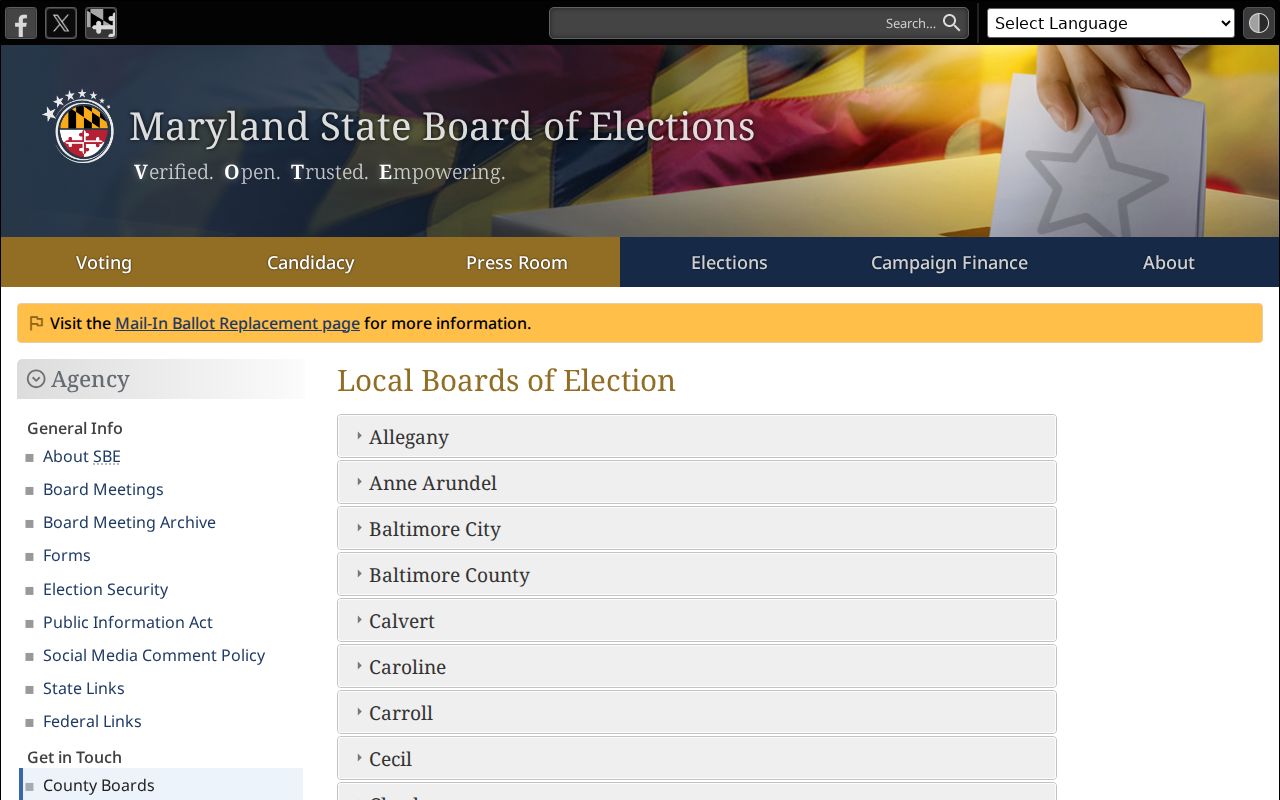
This directory is the best phone and counter fallback when the online voter lookup cannot resolve a current record.
Note: Baltimore City is a county equivalent for election administration and has a board separate from Baltimore County.
Ordering Maryland Voter Rolls
A full list follows a much stricter route than the self-lookup. Under Election Law §3-506, only a qualified Maryland registered voter may receive a copy. The applicant signs under penalty of perjury that the list will be used for a purpose related to the electoral process and not for commercial solicitation or an unrelated purpose. Unrestricted online republication and repurposing as a people finder are not allowed.
- Open the State Board voter-data page and confirm that applications are open.
- Submit a separate application for each list, prove registered-voter eligibility, choose the geography and product, and certify the electoral purpose.
- Pay $125 for each statewide list or $75 for each county, district, or municipality list. A small municipal list may cost less from its local board.
- Choose FTP delivery, a mailed flash drive, or flash-drive pickup. Delivery is due within 10 working days after application and payment are received.
Except for a Walking List, files are tab-separated text without a text delimiter. Statewide and district files can exceed common spreadsheet row limits, and SBE does not supply import software, custom formats, or technical support. In the inspection dated July 19, 2026, the application was temporarily closed until certification of the 2026 Gubernatorial Primary Election. That pause did not end the statutory service.
The Maryland voter-data page is the official place to check products and current availability.
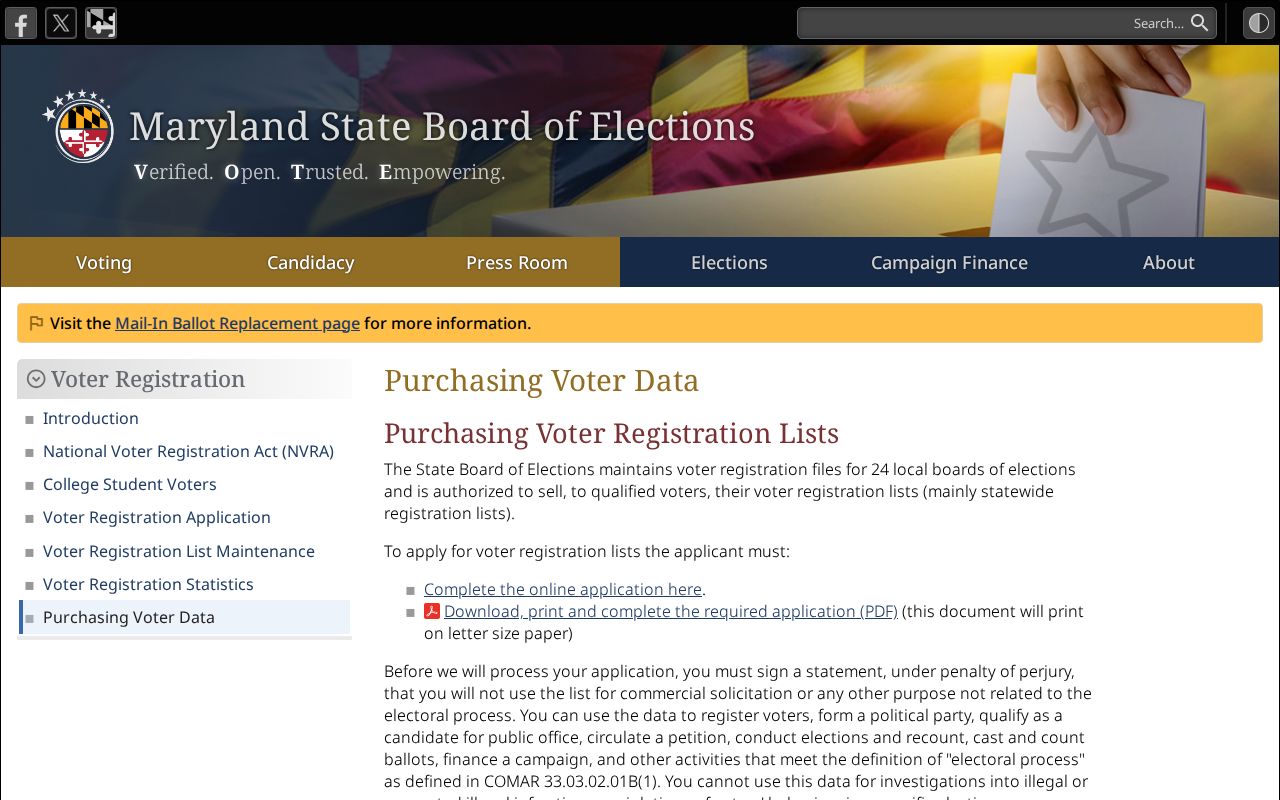
The page separates purchased election data from the free personal lookup and states the eligibility and processing route.
Maryland Registration Status Changes
Maryland reconciles voter rolls with address changes, returned election mail, and official death or eligibility sources. Inactive status is not the same as cancellation. Federal protections prevent cancellation merely because a registrant did not vote, and the confirmation process can span two general elections. A voter should update an existing record instead of creating a duplicate registration.
Registration and updates can be made online, with the statewide paper application, through a Motor Vehicle Administration transaction, or by signed notice to the local board. Signed cancellation may go to the local board or SBE. Party changes generally close three weeks before election day. Aggregate registration statistics by county and party are public reports, but they are counts rather than named voter records.
The official statistics page shows Maryland voter totals without turning the voter rolls into a resident directory.
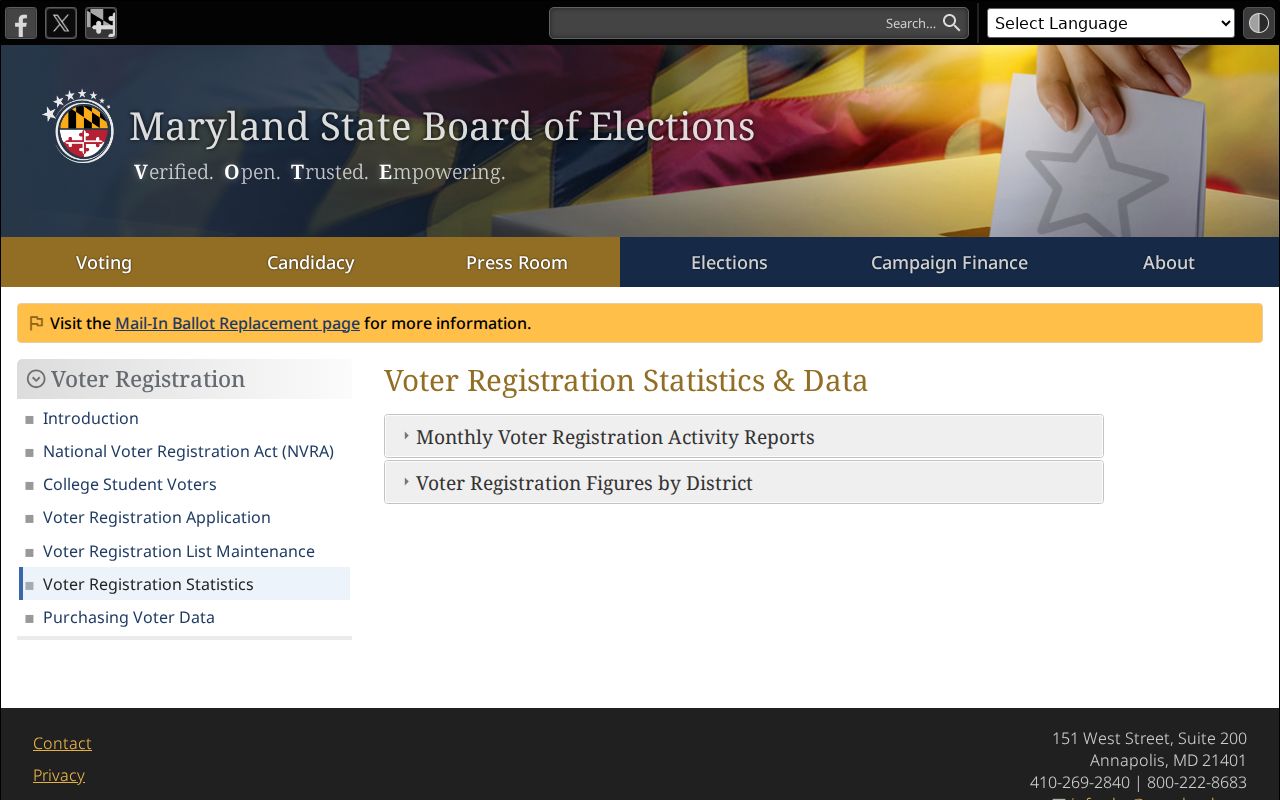
These reports are useful for civic context while preserving the distinction between public totals and restricted list data.
Protected Maryland Voter Addresses
The Secretary of State administers Safe at Home, Maryland’s Address Confidentiality Program. Qualifying survivors receive a substitute address and mail-forwarding service for state and local interactions, including election administration. A substitute or withheld address should never be treated as proof that the voter record is false or absent.
Do not try to connect a protected address to a residence. Public access does not permit stalking, harassment, threats, or evasion of a safety program. A legitimate correction goes through the local board or program staff, never through attempts to reconstruct protected details.
Historical Maryland Poll Books
Older election evidence follows an archival route. The Maryland State Archives Guide describes series held for county boards of supervisors or elections, poll books, registration books, election returns, naturalization records, and older clerk material. Coverage differs sharply by jurisdiction and series, so the catalog’s stated dates should control every claim.
Poll books can show eligibility or participation in a past election. They do not reveal ballot choices. Search by the county that existed at the time, note the series number and date span, then use online images when available. Otherwise, request Archives help or work in the Annapolis search room. Stable series and volume identifiers are more durable than a copied result link.
Historical voter-roll research may also require name variants and parent counties. Maryland’s record trail begins in the colonial era, but it is not one complete statewide series. A careful citation should preserve jurisdiction, record-series title, series number, volume, and page.
Maryland Voter Data Limits
Voter-list use must stay within the sworn electoral purpose. Maryland regulations cover registration, party formation, candidate qualification, petitions, elections and recounts, ballot casting and counting, and campaign finance. SBE also states that its data may not be used to investigate suspected violations of a voter’s behavior in a specific election.
A false application is signed under penalty of perjury. Commercial solicitation, unrestricted posting, stalking, and harassment fall outside the permitted route and may trigger separate legal consequences. When broader access-law context is needed, the statewide system is summarized under Maryland public records, but Election Law remains the controlling authority for voter rolls.
The General Assembly publishes the controlling Election Law §3-506 text on its official statute site.
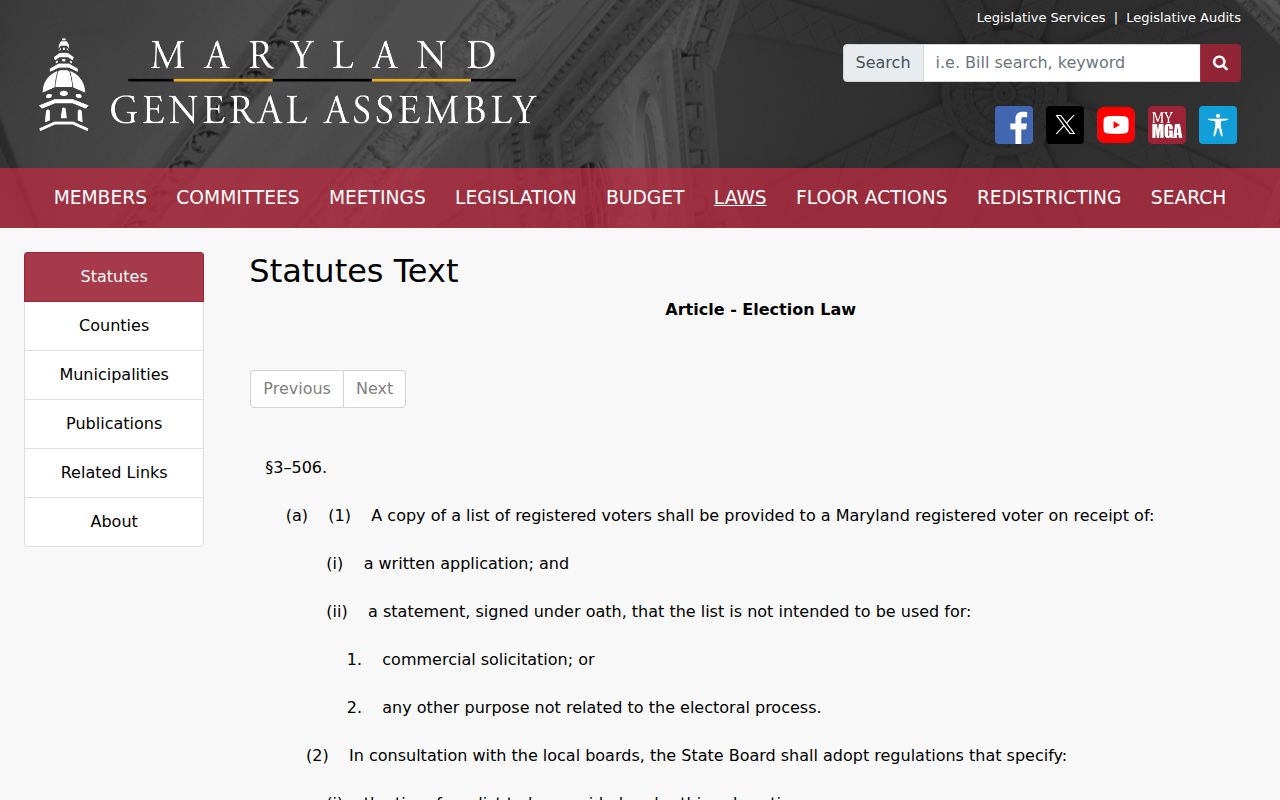
The statute is the primary source for who may receive a list and the sworn restriction on how that data may be used.
Note: Participation history records whether someone was credited as voting, not how that person voted on a secret ballot.