
Maryland Directory Coverage
No official Maryland directory lists everyone. The strongest sources are federated, which means each keeper publishes its own slice. State offices, local boards, schools, universities, courts, license boards, property systems, and libraries all answer different questions. The table leads with what each directory actually lists so a name is not mistaken for proof of residence, ownership, or private membership.
| Maryland directory | Who it lists | Keeper | Access route |
|---|---|---|---|
| Agency and employee directories | Agencies and participating public work contacts | Maryland.gov and DoIT | Free web browse; agency main line fallback |
| Local election boards | Election offices in all 24 jurisdictions | State Board of Elections | Free statewide office roster |
| School and campus directories | Schools, staff, faculty, and visible affiliates | MSDE, local systems, institutions | Separate official directories and phone contacts |
| Land and estate indexes | Recorded parties, decedents, and estate contacts | Circuit clerks and Registers of Wills | Online index plus clerk or register file |
| Professional and entity rosters | Licensees, attorneys, entities, resident agents | State boards, Judiciary, SDAT | Free official search; copies may cost |
| Historical directories | Past residents, firms, students, and officeholders | Libraries, MSA, cultural repositories | Digital volumes, catalog request, or reading room |
Start with a current office roster for a public contact, an institution directory for a campus link, and a professional board for a credential. Use record indexes when the connection is to a deed, parcel, estate, or firm. For an earlier resident, move to the city directory, yearbook, newspaper, or archival series closest to the time and place.
Maryland Government Contact Directories
The Maryland State Agency Directory is the reliable statewide browse route for departments and public contact points. The State Employee Telephone Directory can expose participating employees or offices, but its live interface did not render during research. Entries may also be suppressed for safety, privacy, or operational reasons. An agency page and its main phone line are the right fallback, not an assumption that an omitted name has no state role.
Other government directories are keeper-specific. The General Assembly publishes a current member roster by district. The Governor’s Appointments Office supplies boards and commission information, while meeting minutes can preserve former members. Maryland’s local election-board directory gives one stable statewide model for office entries.
- Jurisdiction: county or Baltimore City.
- Office: board name and building where supplied.
- Location: street, city, state, and ZIP.
- Contact: phone, fax where supplied, and official website.
- Availability: published office hours.
That sample inventory describes public business contacts, not private details. The official agency directory shows the statewide department browse approach.
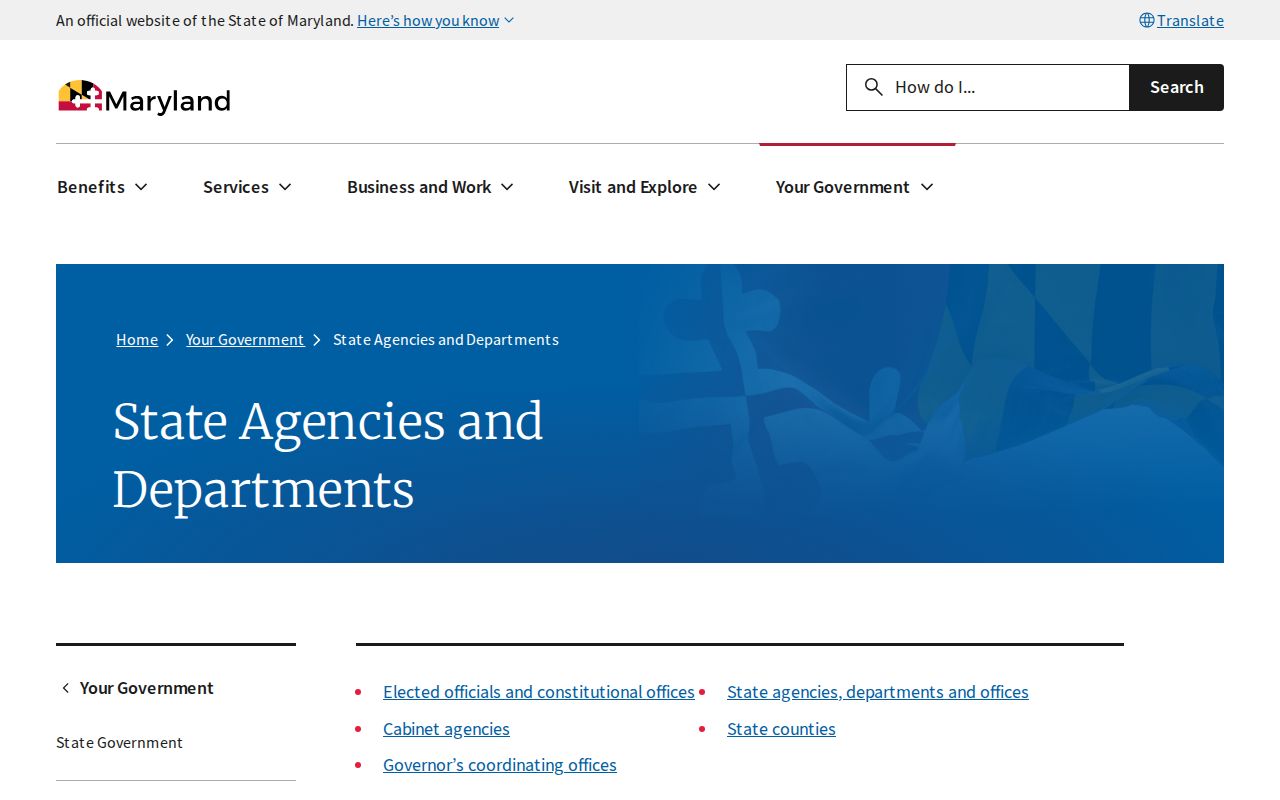
Agency pages reached from this screen can supply a program office or current departmental contact when a person entry is absent.
Note: A missing government-directory result can reflect participation, spelling, contract status, or safety suppression rather than a definitive negative.
Baltimore Government Directory Boundaries
Baltimore City’s government directory is browse and contact oriented. It leads to departments and public-facing officials, not every city worker and never every resident. Department pages may be more complete. When the desired record concerns a permit, agency file, or administrative action, contact the department that created it rather than trying to turn the staff roster into a public-record request.
The distinction between Baltimore City and Baltimore County is critical. They have separate courts, land systems, probate registers, tax routes, and archival series. A postal address using “Baltimore” does not settle the jurisdiction. Check the legal county or city-equivalent before selecting any Maryland people directory.
The Baltimore City directory demonstrates its official department-first format.
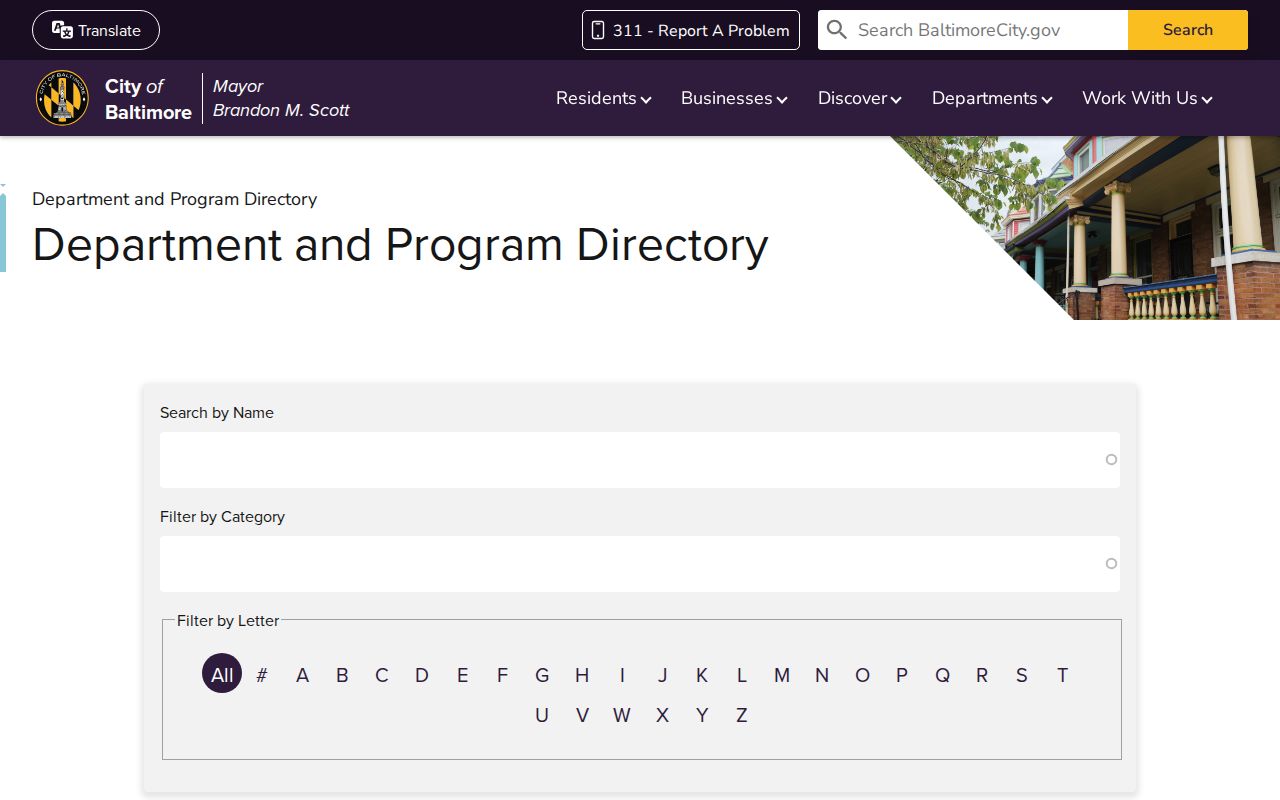
This local roster complements the statewide agency directory while preserving the city’s separate county-equivalent role.
Maryland Education Directory Routes
Maryland has 24 local education agencies. Begin with the MSDE School Report Card or data pages to identify the official school and system, then follow that system’s staff or contact directory. Search controls differ by district. School, last name, first name, department, and role are common concepts, but they are not universal field labels. A school or central-office phone call is the fallback when a person is not shown.
The University of Maryland College Park directory is a current person directory for faculty, staff, and directory-visible affiliates. A typical public entry can include display name, title or university role, department, campus email, business phone, campus address or mail code, and a department profile link. Student and affiliate visibility can be limited by privacy choices.
Name and department are useful concepts, but the live labels, required status, pagination, and wildcard behavior were not confirmed during inspection. Use the campus department page rather than claiming an unsupported search rule.
The University System institution list and Maryland Higher Education Commission college list route users to each campus. Older affiliations call for catalogs, yearbooks, faculty bulletins, and university archives rather than a current staff lookup.
Maryland Record Index Directories
Some official records behave like directories without being resident lists. MDLandRec indexes grantors and grantees to recorded instruments. A free account, jurisdiction, party spelling, date span, and document type can lead to the party role, instrument date and type, and liber/folio or instrument reference. A grantee in an old deed may no longer own or occupy the land.
SDAT property records show assessed owners, mailing and premises addresses, account identifiers, legal descriptions, assessments, and deed or transfer references after a county and search method are chosen. The official ordinary search does not provide a statewide owner-name box, so begin with a known address, account, map or parcel route. Owner mailing and premises addresses can differ, and neither proves who lives there.
- Grantor
- The party transferring an interest in a recorded instrument.
- Grantee
- The party receiving the recorded interest.
- Liber and folio
- The book and page citation used to retrieve the same land record.
- Directory index
- A discovery record that points to a source file but is not the full legal document.
EstateSearch works as a statewide decedent directory. Its index can identify the estate number, jurisdiction, dates, and docket trail, while interested-person lists and other filings must come from the correct Register of Wills. Detailed access-law and copy procedures belong with Maryland public records.
Maryland Professional People Directories
Maryland professional directories are divided among separate boards. The Department of Labor licensing gateway routes to searches for contractors and many regulated fields. Physician profiles, nursing verification, real-estate credentials, and other board records have their own screens and public fields. A result may show name, license number, type, status, expiration, public business contact, and discipline where the board publishes it.
The Maryland Judiciary Attorney Listing provides a free official roster with attorney name, status, and approved public business contact. Sanctions are kept in a separate Judiciary index. Search spelling variants because the roster and discipline records serve distinct purposes.
The attorney directory form illustrates a profession-specific people directory maintained by the licensing authority.
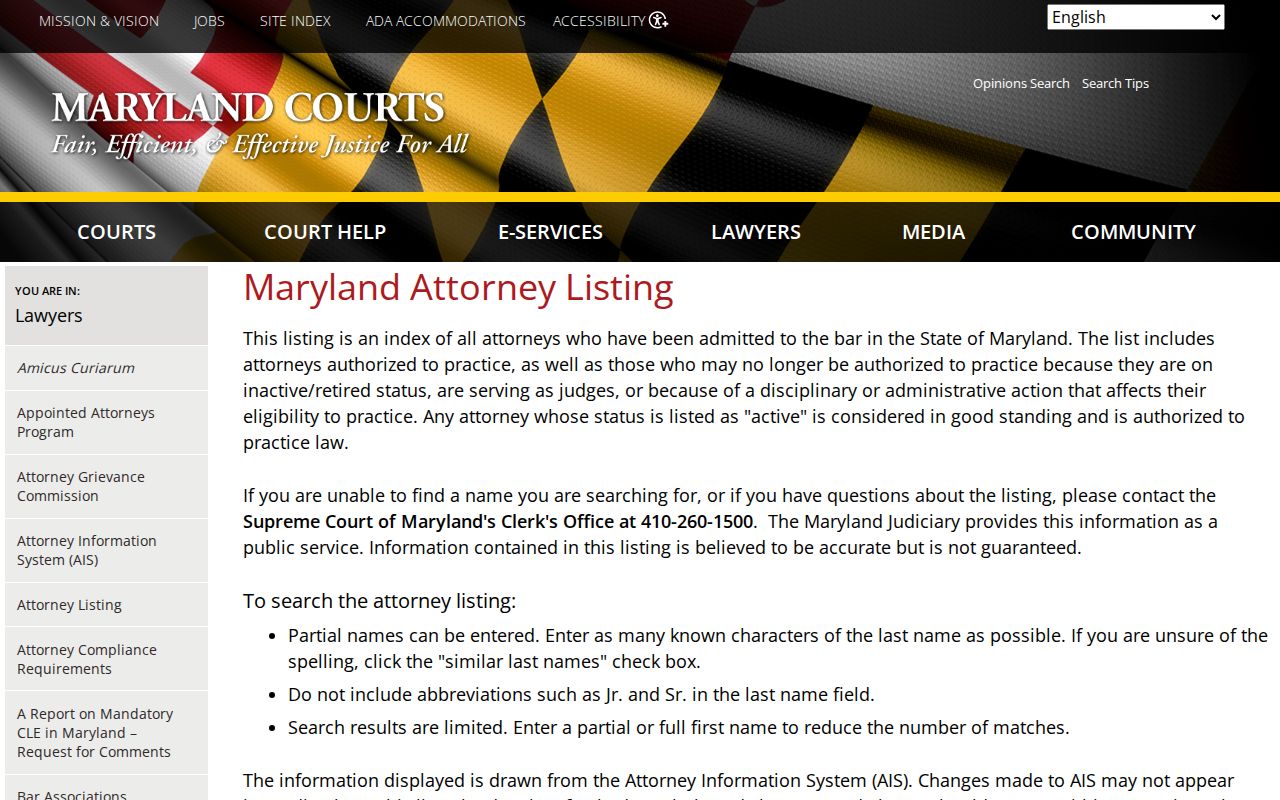
An official credential entry is stronger evidence of professional standing than an undated biography, but its business address should not be read as a home address.
Maryland Business Directory Layers
The Maryland Business Express entity search is a directory of corporations, limited liability companies, limited partnerships, and registered trade names. Users can search by business name, a Department ID made of one letter and eight digits, or a nine-digit EIN. Entity details may show the legal name, entity type, status, formation date, principal office, resident agent, and public filing choices.
| Directory field | Control | Required rule | Format |
|---|---|---|---|
| Search by | Radio group | Yes | Business Name, Department ID, or EIN |
| Business Name | Text | When selected | Free text; no official minimum is stated |
| Department ID | Text | When selected | One letter followed by eight digits |
| EIN | Masked text | When selected | Nine digits; displayed as xx-xxxxxxx |
A resident agent receives legal process and is not necessarily an owner. Circuit-court business-license records answer a different question by connecting a trade or licensee to a type, place, number, and issuing jurisdiction. Professional boards answer whether an individual holds a regulated credential. Search all relevant layers before drawing a conclusion from one directory.
Three-part check. Entity status, a clerk-issued business license, and an individual credential come from separate Maryland keepers.
Trade names are state registrations rather than one uniform county DBA system. Copies and certificates may cost even though the basic entity directory is free. Save Department IDs and license numbers because those stable keys often outlast bookmarked result pages.
Historical Maryland People Directories
Baltimore city directories are a rich name-and-address spine. The Enoch Pratt Maryland Department holds Maryland books, newspapers, maps, genealogy tools, and city-directory material. Digitized Baltimore volumes span parts of the nineteenth and twentieth centuries, but no official source confirms one complete continuous run. Verify each year in a catalog before claiming coverage.
Entries can list a head of household, spouse or widow notation, trade, employer, business ad, and street address. Later reverse or criss-cross editions may turn an address into an occupant. These printed snapshots omit many women, boarders, children, rural residents, immigrants, Black residents, and anyone missed by a publisher’s canvass. Absence is weak evidence.
| Historical directory kind | Possible entry | Maryland keeper or route | Coverage caution |
|---|---|---|---|
| City directory | Name, trade, spouse note, address | Pratt, MCHC, local libraries | Confirm the exact volume year |
| Reverse directory | Street address to occupant | Local-history shelves and microfilm | Not every year includes one |
| Telephone book | Listed subscriber or business | Library catalogs and Library of Congress | Unlisted and mobile numbers absent |
| Yearbook | Portrait, class, activity, faculty role | Digital Maryland and campus archives | Publication does not prove graduation |
The Pratt local-history guide shows the library route into Baltimore and Maryland collections.
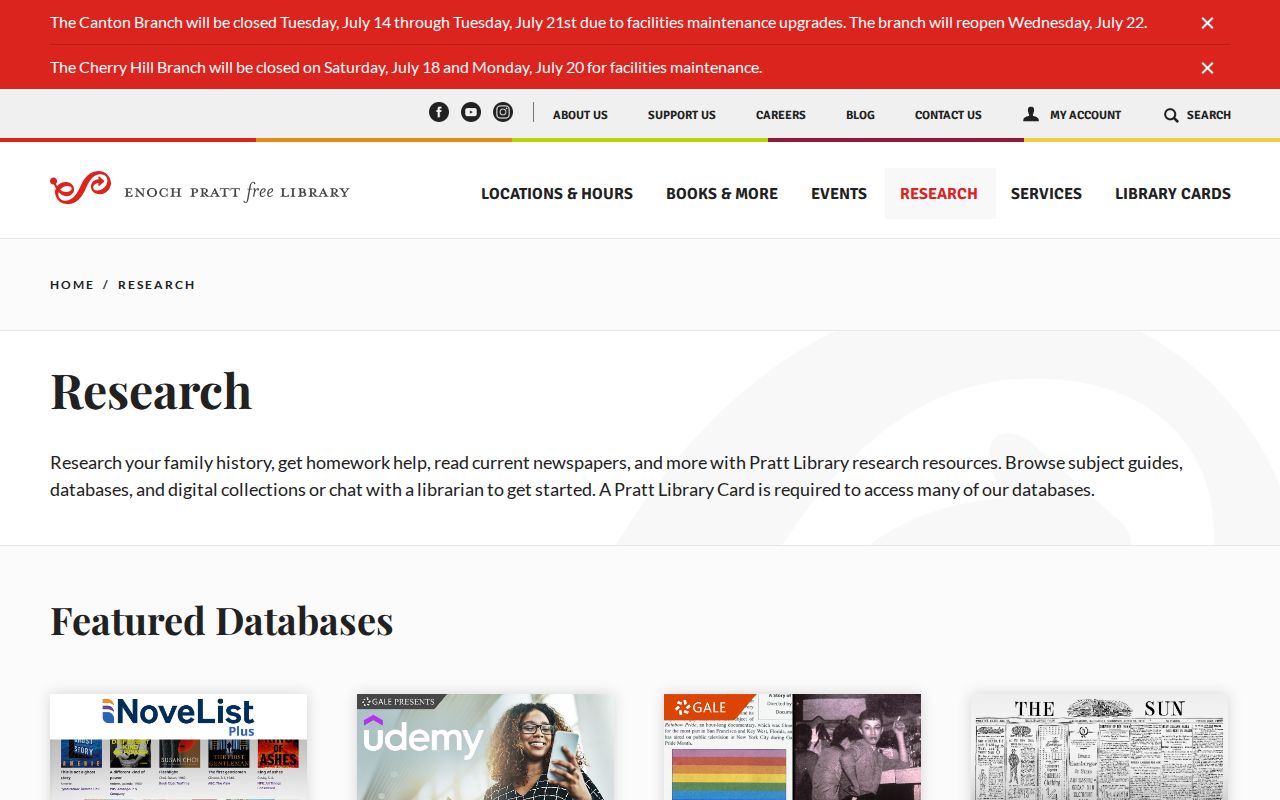
Its catalog and Maryland Department can identify physical, microfilm, and licensed resources that do not appear in a general web search.
Maryland Directory History Timeline
Maryland’s people directories sit inside a longer record history. Modern statewide portals did not replace local custody or older volumes. They added new discovery layers while book, film, and archival identifiers stayed vital.
- 1634: Maryland’s colonial documentary trail begins, though surviving records are not one unbroken statewide series.
- 1790: The first federal census includes Maryland; public population schedules now run through 1950.
- Nineteenth and twentieth centuries: City directories serve as snapshots between censuses, followed by reverse and telephone editions where published.
- 1935 to 1936: Maryland creates the Hall of Records Commission and opens the Annapolis Hall of Records, later the State Archives.
- Digital era: MDLandRec, EstateSearch, license databases, and institutional directories place selected indexes online while source files remain distributed.
A directory search should preserve the year, jurisdiction, title, page, archive series, and stable record number. Those details help staff retrieve the same source after a portal changes. For early land, the MSA Guide can carry a researcher from colonial patents and tract names into later county deeds.
Regional Maryland Archive Directories
Historical Maryland research is regional. The State Archives covers government records across all counties and Baltimore City. Pratt and the Maryland Center for History and Culture are strong for Baltimore. Hornbake Library holds statewide institutional, political, labor, and community collections. The Nabb Research Center adds deep Delmarva and Eastern Shore coverage across modern state boundaries.
Digital Maryland gathers yearbooks, photographs, newspapers, maps, manuscripts, and local collections from participating institutions. Metadata and full text can be searched where available, then narrowed by collection or contributor. The MSA Legacy of Slavery database joins freedom records, runaway advertisements, manumission, and related sources, providing names that standard surname directories may miss.
No statewide open residential phone book, alumni directory, congregation roster, club list, or association-member directory exists. Those sources are fragmented and often private. Use a keeper’s public officer page, donated archival collection, yearbook, or finding aid. Ethical contact goes through the organization or archive rather than attempts to expose private members.
Note: Search a historic-property narrative PDF as well as catalog metadata because occupant names may appear only inside the report.