
Maryland Records Open to Inspection
Maryland does not keep one master file of people. State systems help locate many public records, but the source file often belongs to one of 23 counties or independent Baltimore City. A circuit-court clerk records land instruments and keeps court and local marriage files. Each Register of Wills keeps probate papers. The State Department of Assessments and Taxation, or SDAT, publishes assessment data, while local finance offices keep tax bills. The first question is not simply whether a record is online. It is which keeper has legal control of it.
| Maryland record | Legal keeper | Web entry point | Other access |
|---|---|---|---|
| Deeds, mortgages, liens | Filing circuit-court clerk | MDLandRec index and images | Clerk or Archives terminal; plain or certified clerk copy |
| Public court dockets | District or circuit clerk | Judiciary Case Search & Record Portal | MDEC terminal, clerk counter, copy request |
| Property assessments | SDAT; local tax office for bills | Real Property Data Search | Local assessment office and county GIS |
| Probate estates | Register of Wills | EstateSearch | Written or in-person file request |
| Vital certificates | Vital Statistics Administration, clerks, Archives | Applications, not a public modern-name index | Mail, lobby, local health department, archive |
| Custody and registry data | DPSCS or registry authority | Official locator or registry | Agency contact or focused MPIA request |
Agency possession alone does not guarantee release. Sealed, shielded, expunged, juvenile, adoption, protected-address, medical, and some active-investigation material may be withheld. Driver data remain subject to the federal Driver's Privacy Protection Act. Recent vital certificates require proof of eligibility. Maryland court access follows court rules, not the MPIA alone. A public index may omit a protected case while the records law still guards the file.
Maryland Land Records After 2025
The MDLandRec gateway serves all 24 recording jurisdictions through a Judiciary and Maryland State Archives partnership. Its fall 2025 replacement required new credentials and two-factor authentication, and it changed remote page access. That makes older instructions and saved result links unreliable. An account leads to indexes and land-record images, but it does not issue a certified copy. The clerk that holds the original does that.
Coverage varies by county, Baltimore City, series, and digitization. Some books reach into the colonial period, yet there is no honest single statewide start year. Search both grantor and grantee roles. A grantor gives an interest; a grantee receives one. Try initials, spouses, entity names, and spelling variants. Save the liber and folio, meaning the record book and page. Those references can retrieve an image long after a portal changes.
| MDLandRec control | Input | Required? | Useful detail |
|---|---|---|---|
| County | Dropdown | Yes | Choose a county or Baltimore City |
| Search type or index | Menu | Yes | Choices vary by jurisdiction and series |
| Party or last name | Text | Conditional | Use the indexed surname or entity name |
| First name and role | Text and selector | No | Try variants; search grantor and grantee |
| Date range | Date pair | No | Use recording dates |
| Liber and folio | Text or number | Conditional | Direct book-and-page retrieval |
Subdivision and condominium plats use the separate Plats.net system. If a land index fails, check the courthouse terminal, ask the filing clerk about unscanned books, or search the Archives series guide. This split between deeds and plats is a Maryland records quirk, not proof that a survey is missing.
Note: Keep the county, liber, folio, instrument number, and date together because durable identifiers outlast changing portal screens.
Maryland Property Records Reveal Context
The SDAT Real Property Data Search covers roughly two million accounts and is updated daily. It can show the deed owner, premise address, owner mailing address, parcel account, assessed values, sales, transfer references, tax class, and land or improvement facts. Yet its public interface does not accept an owner-name search. Select the county, then search by street address, account identifier, or map and parcel reference.
The premise, sometimes called the situs address, is the physical property. The mailing address is where the owner receives notices, and it may be different. That distinction can explain an apparent mismatch without showing that either record is wrong. Local GIS adds parcel shape and map layers, but it is not a legal survey. Local finance offices, not SDAT, control current bills, payment histories, and tax-sale data. When online data look wrong, the local SDAT assessment office is the help and correction channel.
Practical pointer. Use an SDAT parcel account to reach the deed reference, then take its liber and folio to MDLandRec. Do not assume the owner occupies the property.
Maryland Court Dockets and Files
Maryland launched its combined Judiciary Case Search & Record Portal in March 2026. Public users retain summary access to public case information. Search routes include person, company, and case number, with court, county, case type, and filing dates available to narrow results. A trailing percent sign supports partial first or last names under the portal's rules. Broad searches return no more than the first 500 matches, so a court and date range matter.
A docket is the court's event list, not the whole file. Results may show case number, party name and type, court, case type and status, filing date, caption, and a date of birth when public. Detail can include charges, dispositions, scheduled events, and document entries. Pleadings, exhibits, and certified copies remain with the clerk. Use an MDEC public terminal or the clerk counter when web detail is incomplete. Archived files may need advance retrieval.
The transition itself is useful context. A conversion issue delayed the portal before launch, so old bookmarks and screenshots may coexist with the current system. A dead result URL does not prove that a case vanished. Save the case number, court, parties, and filing date. For federal District of Maryland cases, PACER and courthouse terminals are separate federal channels.
See the Judiciary's court-record access guidance before ordering. Administrative Judiciary records use an MPIA channel, but a case file goes to the clerk and cannot be opened by routing around court access rules.
Maryland EstateSearch Connects Families
The statewide EstateSearch portal is an index into probate, not the probate file itself. Select the filing county or Baltimore City, then search by surname, first name, estate number, or date criteria. A trailing percent sign can find a partial name. The full estate number has 12 characters and may need leading zeroes. Results over 500 show only the first 500, which makes a date or first name useful.
An estate entry can identify a decedent, jurisdiction, estate number, representative, status, dates, and docketed filings. The petition, list of interested persons, inventory, account, and distribution papers may identify relatives and addresses, subject to sealing or redaction. That makes probate a sound path for an heir or family reconnection. Ask the relevant Register of Wills for copies in writing or in person. Use the domicile jurisdiction, not automatically the county where the decedent owned land.
Maryland Vital Records Stay Restricted
Modern birth and death certificates are not an unrestricted public name index. The Maryland Division of Vital Records accepts record-specific applications, proof of identity, and proof of relationship or authority. Birth and death access rests chiefly on Health-General sections 4-217 and 4-225 plus current VSA rules. Marriage files may be held by the circuit clerk that issued the license, while VSA issues eligible statewide products. A VSA divorce verification confirms limited facts; the divorce decree comes from the circuit clerk.
Maryland publishes no single closure period that fits every birth, death, marriage, and divorce series. Do not apply one made-up year rule. For older records, search the Maryland State Archives Guide by record type, jurisdiction, series, and year. The result will show whether a series is online, available for an order, or limited to a reading-room visit. VSA accepts online, mail, and lobby orders, and some local health departments issue certain birth or death certificates.
The official VSA source and ordering routes are shown in the captured portal below.
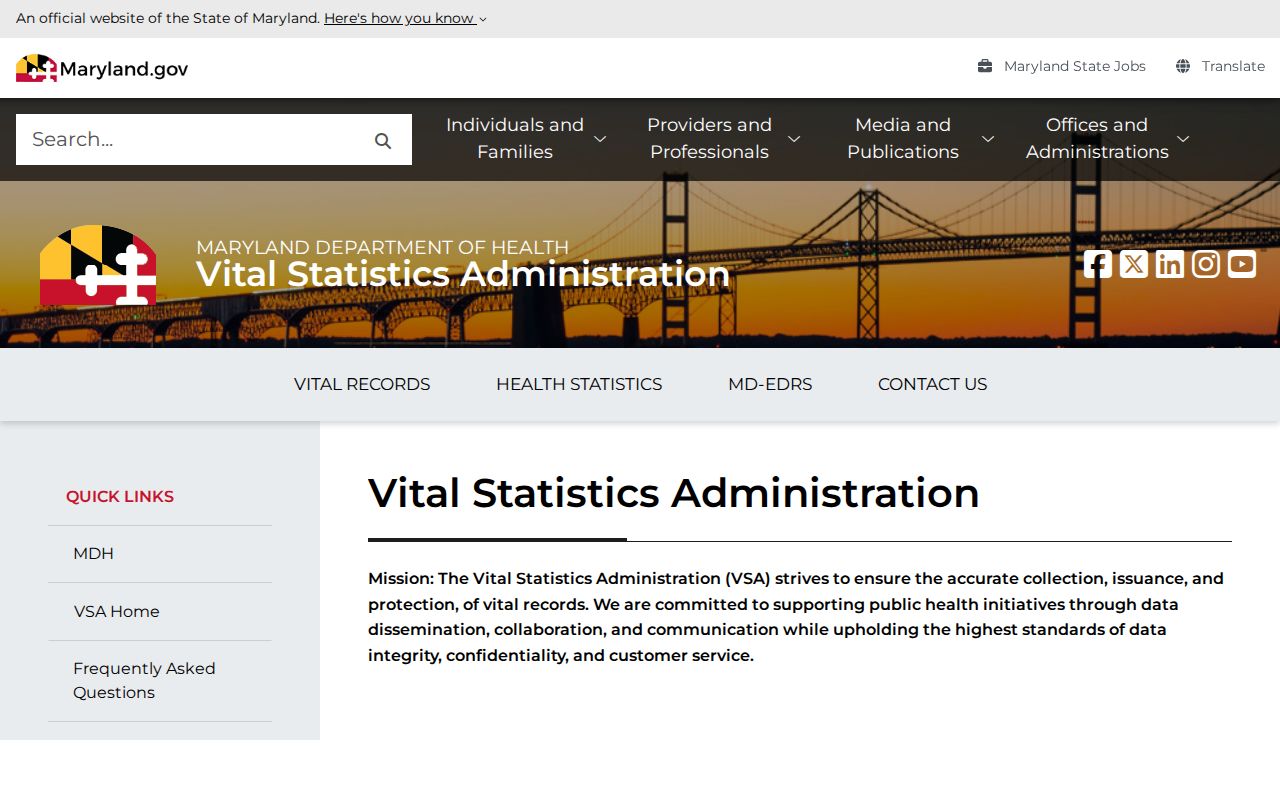
The application route matters because a general records-act letter cannot replace the certificate form, identification, eligibility proof, and payment.
Maryland Public Records Custodians
Maryland public records offices divide work by legal function. The statewide portal helps with discovery, but the local keeper supplies the source file. Baltimore City appears as its own county-equivalent choice and must not be confused with Baltimore County. The cards below identify three key statewide entry points. For circuit files and deeds, use the directory of circuit-court clerks to reach the right jurisdiction.
Division of Vital Records
6764B Reisterstown Road
Baltimore, MD 21215
Certificates and applications
Maryland State Archives
Annapolis, Maryland
Records and research gateway
Maryland Judiciary
District and circuit courts statewide
Case Search & Record Portal
The Archives records gateway appears in the image below and routes research by record type.
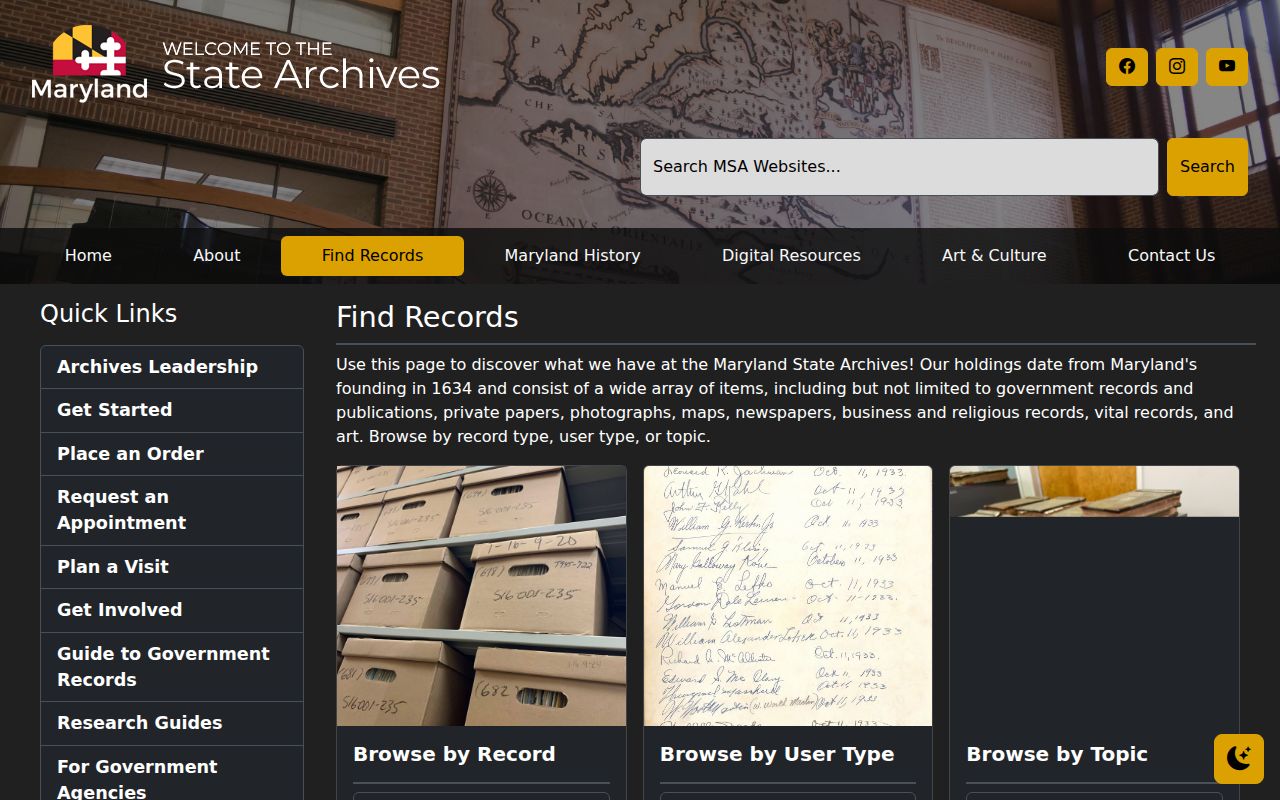
Its series descriptions bridge web indexes to older county books, transferred vital series, probate material, and records that require an order or visit.
Maryland Records Law Has Boundaries
The MPIA does not override a more specific confidentiality law. Adoption and many juvenile files stay restricted. Sealed, shielded, or expunged cases may be absent from the court portal. Medical details, protected identifiers, personnel files, protected voter addresses, and some victim or active-investigation facts can be withheld. Agencies should release a separable public portion after redacting protected content when the law permits.
Safe at Home gives qualifying survivors a substitute address and mail forwarding. A withheld address is not proof that no record exists, and no search should try to defeat that protection. The Maryland Online Data Privacy Act governs qualifying commercial-data practices, but it does not rewrite official deeds, court dockets, or archival sources. Source correction, a court shield, land-record redaction, and downstream commercial deletion are different legal paths.
- Custodian
- The agency or official that keeps and controls the requested record.
- Index
- A finding tool that points to a file or image, not always the legal record.
- Certified copy
- A copy authenticated by the keeper for an official purpose.
- Exemption
- A law or rule allowing or requiring some content to be withheld.
Note: A missing online entry may reflect access limits, archive transfer, local indexing, or portal change rather than a missing source file.
File Maryland Public Records Requests
The Maryland Public Information Act, General Provisions Title 4, gives a person or governmental unit a right to inspect existing public records, subject to exemptions. Send the request to the actual custodian. Agencies may accept email, a web portal, mail, or an in-person submission. The law does not demand magic wording, and it does not require staff to perform research, answer questions, or create a new database.
- Find the keeper. Identify the agency component and check its portal, clerk counter, or published request route first.
- Describe existing records. Give names, subject, date range, jurisdiction, case or account number, and the format sought.
- Control the cost. Ask for an estimate, set a fee ceiling, request electronic inspection, or explain a public-interest waiver request.
- Save proof. Keep the signed request and delivery record. If more than ten working days are needed, the custodian should provide timing, reason, and a fee range.
- Review the response. A grant or denial is generally due promptly and no later than 30 days, unless a longer period is agreed or allowed. Ask for the legal basis and review rights after a denial.
General Provisions section 4-206 ordinarily excludes the first two hours of search and preparation from charge. Other actual search, preparation, reproduction, and certification costs may apply, and prepayment may be required. A narrow request built around a case number, estate number, parcel account, or liber and folio can reduce cost and wrong-person matches.
If a dispute remains, clarify or narrow it with the custodian. The Public Access Ombudsman offers mediation, and the State Public Information Act Compliance Board handles disputes within its current authority. Judicial review is also available under General Provisions section 4-362.
Lawful use. Open access never permits stalking, harassment, threats, intimidation, fraud, or an attempt to uncover a protected address. Confirm identity before acting on a same-name result.
Every Maryland Portal Needs Fallbacks
Online indexes are the fast route, not the only route. Deeds and court files lead back to circuit-clerk counters and public terminals. Probate copies come from a Register of Wills by written or in-person request. Vital records use VSA forms, mail, lobby service, approved online ordering, and some local health departments. State Archives series may be ordered or viewed in a reading room. Local libraries preserve directories and newspapers that no agency portal carries.
For custody records, use the DPSCS locator, then contact the institution or submit a focused request for a releasable agency record. Accident reports go to the investigating police agency, not automatically to DPSCS. For local tax history and GIS, contact the county or Baltimore City finance, assessment, or mapping office. When the special record law controls, use its form rather than trying MPIA as a shortcut.
The Maryland Judiciary access page shown below distinguishes public docket access from clerk-held documents and copies.
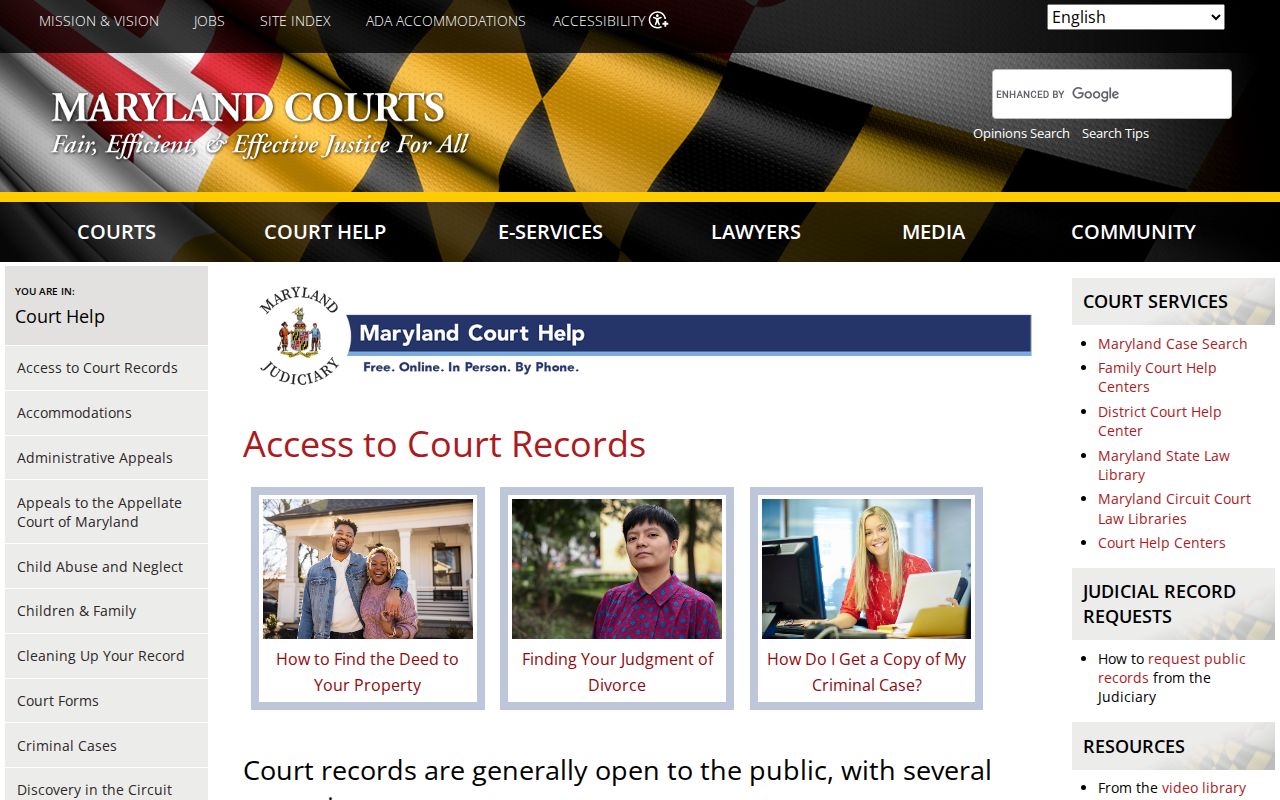
That distinction is the core of Maryland's records system: find the stable identifier online, then ask the legal keeper for the source material.