
Build a Maryland People Search
Begin with the fact least likely to change. A case number, estate number, parcel account, license number, or land-record liber and folio will outperform a broad name query. A liber is a deed book and a folio is its page. If only a name is known, use a statewide party index, then narrow by county, date, and record type. If an address is known, identify the property account first. Maryland systems share these stable references even though no single portal searches them all.
A phone number may help confirm a current contact, but official records index names, addresses, parcels, cases, or credentials. Try spelling variants and initials before ruling out a match. Keep a log of the mode, date, county, and filters used. That makes a negative result useful.
- Search the Maryland court party index and note the court and case number.
- For a known address, use SDAT to capture the parcel account, owner spelling, and deed reference.
- Follow the deed citation in MDLandRec, checking both grantee and grantor roles.
- Check EstateSearch when death, inheritance, or kinship may explain a move.
- Use the custodian's counter, mail channel, or focused request when the web index ends.
Maryland People Records Custodians
Maryland combines statewide discovery with local custody. The Division of Vital Records issues recent certificate products. The State Archives preserves transferred series and helps operate land-record access. Each county and Baltimore City has a Circuit Court clerk for deeds, marriage licenses, and court files, while a Register of Wills keeps probate. The full request paths belong with the Maryland public records system; first identify which office owns the original.
Maryland State Archives
Annapolis research services
State and local historical series
Circuit Court Clerks
23 counties and Baltimore City
Land, marriage, and court files
Maryland Has 24 Record Jurisdictions
The state has 23 counties plus independent Baltimore City. That line affects deeds, probate, courts, elections, tax accounts, and archives. Baltimore City and Baltimore County have separate clerks and Registers of Wills. A postal address saying Baltimore does not settle the custodian. Columbia is not incorporated, and Silver Spring covers several communities. Confirm the legal jurisdiction through a parcel account or local map.
Statewide portals can look centralized, yet local offices retain the legal files. Older evidence can sit under a parent county that existed at the time. Across the Chesapeake and near state borders, practical ties may also lead into a neighboring county or state.
Trace Maryland Deeds in MDLandRec
Open the official MDLandRec gateway for land indexes and images from all 24 recording jurisdictions. The system, supplied by the Judiciary and State Archives, requires an account and two-factor authentication. Coverage varies by county and series, so a missing image may still exist at the clerk or Archives.
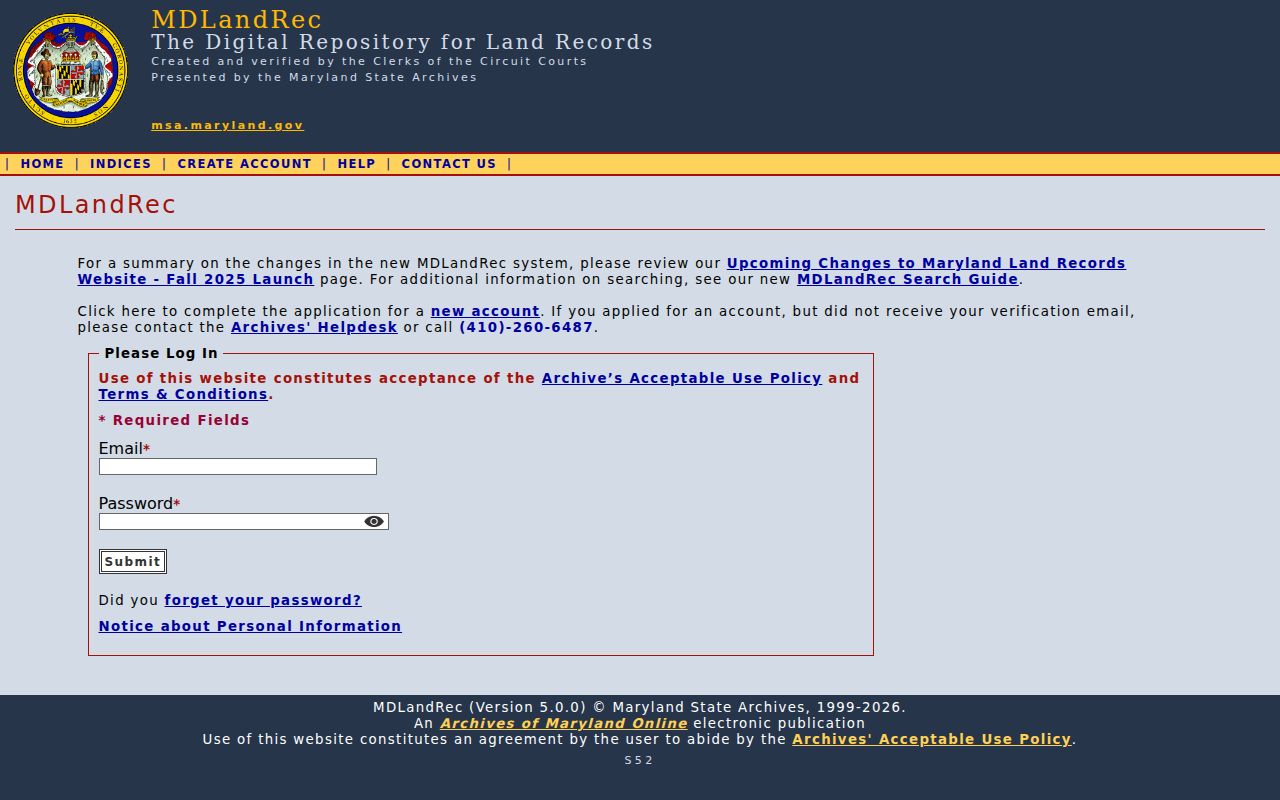
The gateway leads to party indexes, book-and-page retrieval, and deed images. Search a person as both grantor, the party transferring land, and grantee, the party receiving it. A deed's prior-title recital can lead to an earlier liber and folio.
| Search field | Maryland people-search use | Limit |
|---|---|---|
| County | Select one of 24 jurisdictions | Baltimore City is separate |
| Party name | Try surname, given name, initials, or entity | Index rules vary |
| Party role | Check grantor and grantee | Both matter for a chain |
| Date range | Narrow by recording date | May differ from signing date |
| Liber and folio | Retrieve a known deed citation | Clerk certifies copies |
Note: Plats use the separate Plats.net system, while unscanned books and certified copies require the responsible court office.
Maryland Property Records Reveal Links
SDAT Real Property Data Search starts with a county and then an address, account identifier, or map-and-parcel reference. It does not offer an ordinary statewide owner-name search. With a known address, its parcel card can show the deed owner's recorded name, premise address, mailing address, account number, transfer facts, and deed reference. The mailing address can be useful, but it may point to a trust, manager, business, or old destination.
Use SDAT's exact owner spelling and liber/folio to move into MDLandRec. Local GIS can confirm parcel context, though it is not a survey or proof of title. Maryland warns that an official street number may differ from the one an owner uses. Remove directionals and suffixes, omit the number, or use the supported trailing wildcard when an address fails.
Address trail: street address → SDAT parcel account → owner and deed citation → MDLandRec image → prior owner.
Search Maryland Court Records by Name
The Maryland Judiciary Case Search covers public District Court, Circuit Court, and appellate docket information. Search by person, company, or case number, then narrow by court, county, type, and filing date. Results can show party role, court, case number, status, caption, and date of birth when public. Maryland has no separate municipal court tier.
A web docket is a summary, not the complete file. Sealed, shielded, expunged, adoption, juvenile, and other protected matters may be absent. Some public criminal information no longer shown remotely can still be inspected at the courthouse. Take the case number to the clerk for the file or copies.
| Maryland court source | What it identifies | Online route | Fallback |
|---|---|---|---|
| District and Circuit Courts | Parties, cases, status, dates | Case Search | Filing court clerk |
| Orphans' Courts | Decedents and estates | EstateSearch | Register of Wills |
| District of Maryland | Federal parties and dockets | PACER | Federal court terminal |
Access Maryland Vital Records
The Division of Vital Records issues recent birth and death certificates, marriage products, and divorce verifications. Local health departments issue certain birth and death certificates. Circuit Court clerks hold local marriage-license files and divorce cases, while the State Archives holds transferred historical series. A divorce verification confirms limited facts; the decree comes from the Circuit Court file.
Recent certificates are restricted under Maryland law and current application rules. Eligibility, identification, form, and fee depend on the record. Maryland does not publish one universal number of years after which every vital record opens. For genealogy, search the Archives Guide by event, jurisdiction, and year to learn whether a series is online, orderable, or search-room only.
- Certified copy
- An official copy bearing the custodian's certification.
- Verification
- A statement confirming selected facts, not the full decree.
- Index
- A finding aid that points to a record but may not reproduce it.
- Custodian
- The office responsible for the legal record.
Maryland Estate Search Finds Family
Search Maryland EstateSearch by county and surname, with an optional first name, date, or full estate number. A trailing percent sign permits a partial name. Broad results stop after 500 matches, so add a date or given name. A result can identify the decedent, estate number, jurisdiction, representative, status, and docket events.
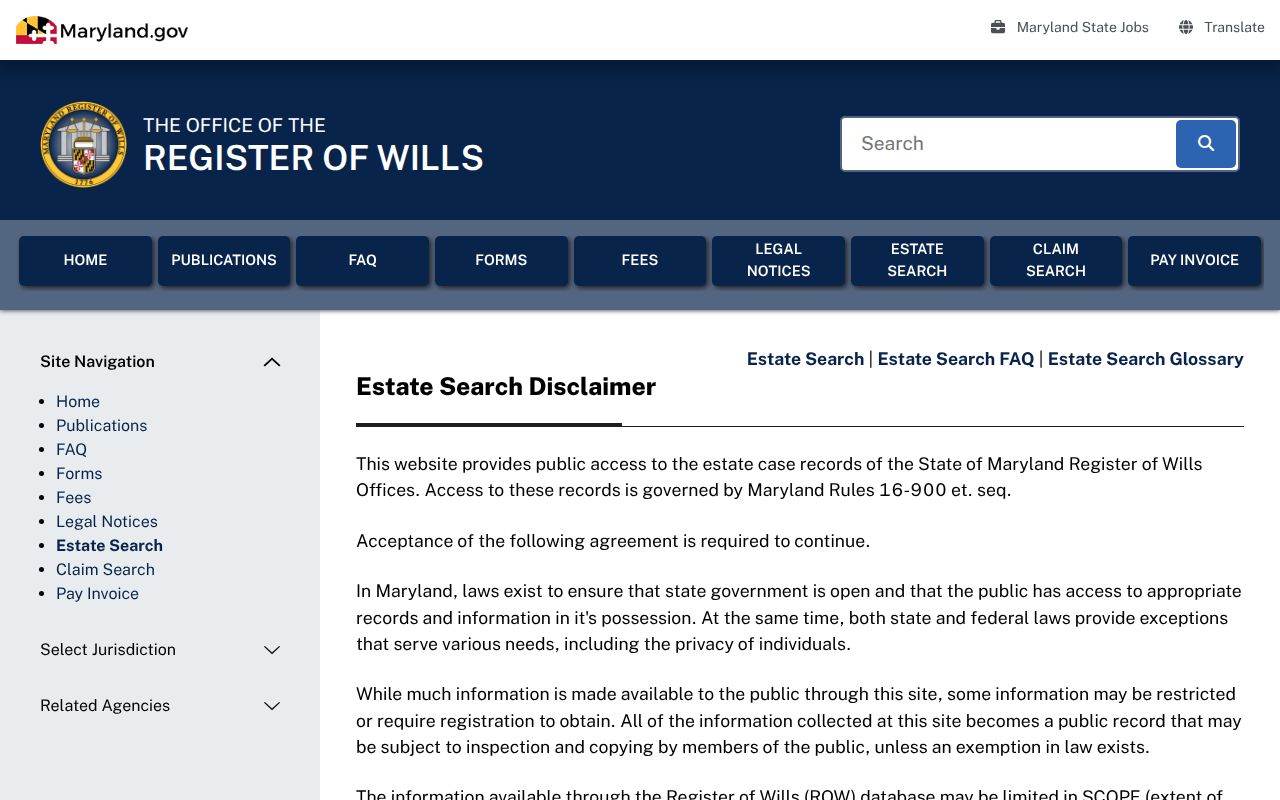
The index opens a richer offline trail. Ask that jurisdiction's Register of Wills for public petitions, lists of interested persons, inventories, accounts, and distribution papers. Those papers may identify kin and addresses. Search the county of domicile, not just the county where land was owned, then compare the estate with inherited property and obituaries.
Confirm a Maryland Voter Record
Maryland Voter Lookup is exact-match self-service, not an open name directory. It requires first and last name, full date of birth, ZIP code, and street number, with middle initial optional. An old address, changed name, or mistyped number can cause a failed match. Contact the local election board when the lookup fails or the record needs an update.
Bulk lists follow a different rule. Election Law §3-506 limits copies to qualified Maryland registered voters who swear to an electoral-process use. Protected addresses and sensitive authentication data are not general search material. More detail appears in the Maryland voter registration lookup.
Search Maryland Business Identity Records
Use Maryland Business Express Entity Search by business name, Department ID, or federal tax ID. Results can connect an entity with its status, principal office, resident agent, filing history, and public documents. A resident agent accepts legal service; that person is not necessarily the owner, and a principal office is not proof of a home address.
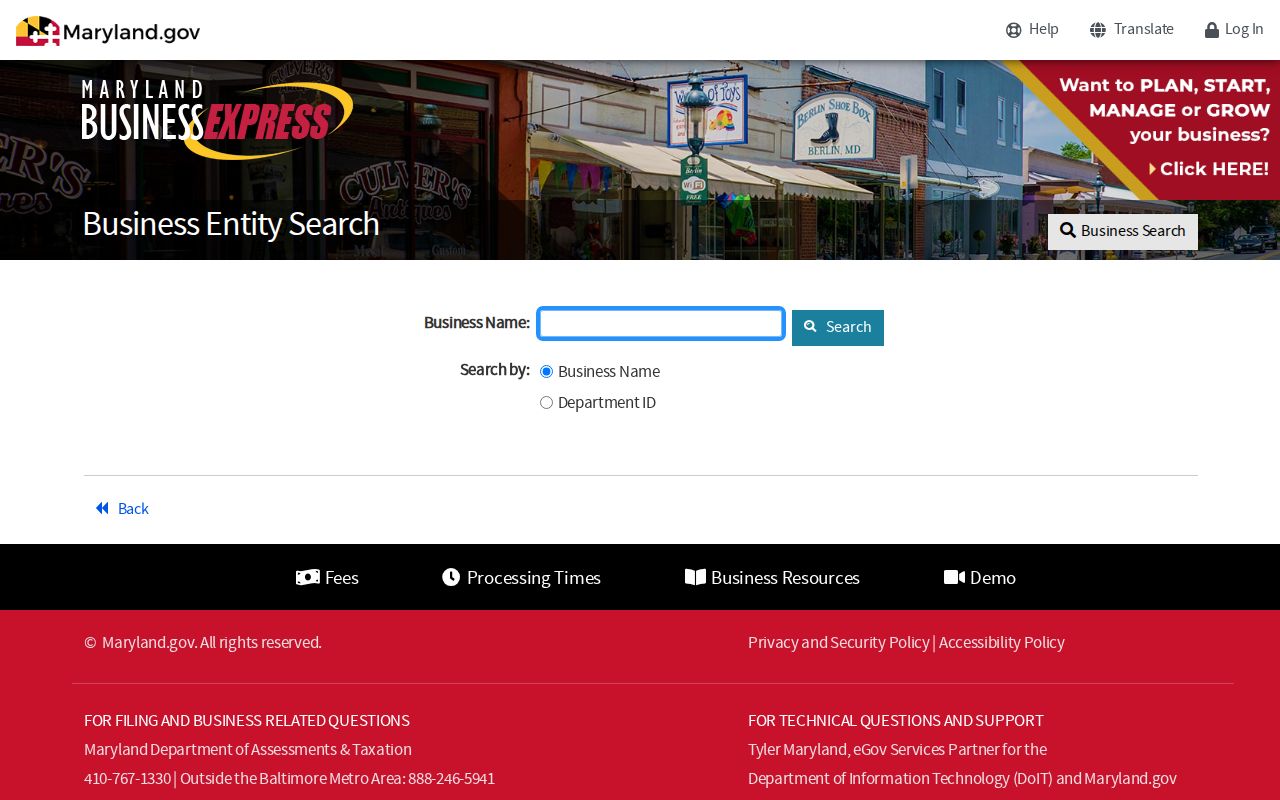
The entity screen yields a firm identifier for comparison with cases, deeds, and credentials. Maryland licensing is split. Circuit Court clerks issue many local business licenses, specialized boards regulate practitioners, and SDAT maintains entities and trade names. No one search covers all three.
Verify Maryland Professional Licenses
Browse the Maryland Department of Labor licensing gateway for board-specific searches. Depending on the board, a record may show name, profession, credential number, status, expiration, and public discipline links. Health professions use separate boards, and the Judiciary maintains the attorney roster.
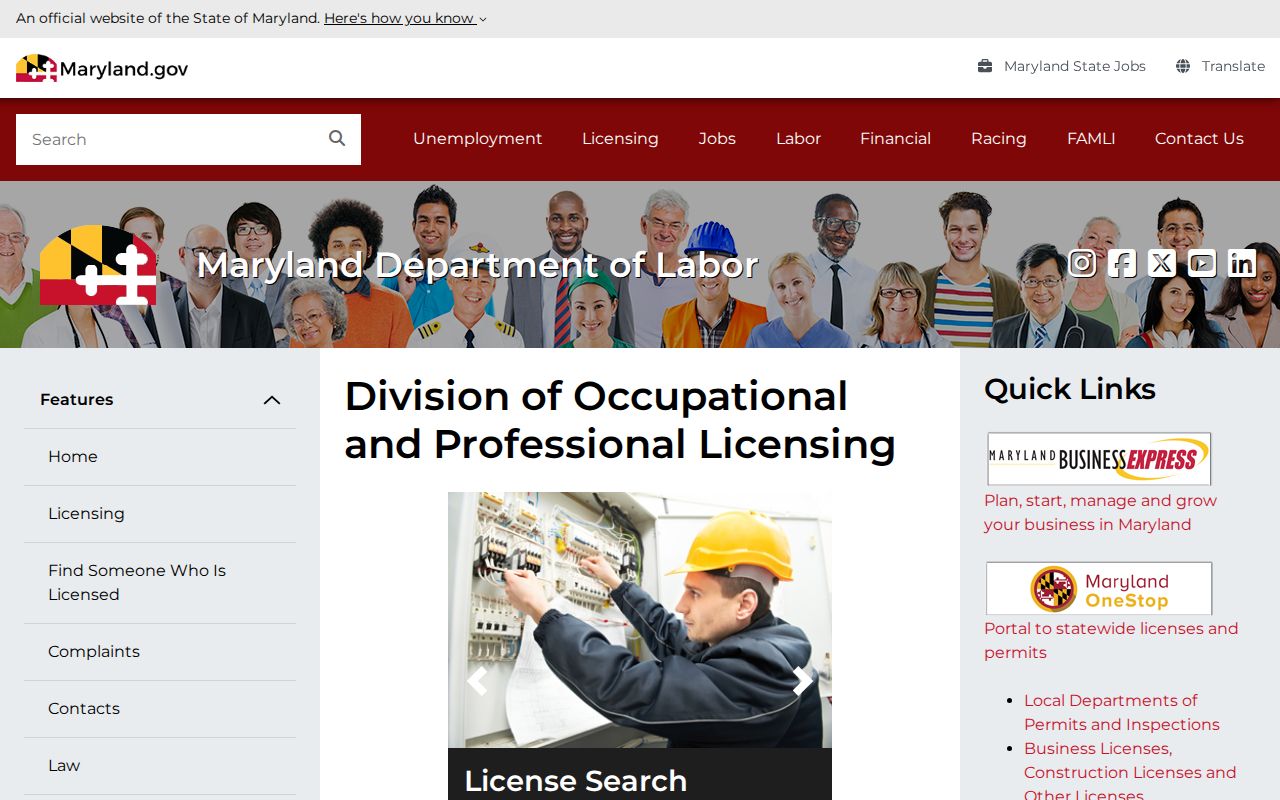
Compare the credential number and exact name with another official source. Practice and mailing addresses identify a professional location, not necessarily a residence. When details are unclear, contact the board for certified verification or public disciplinary documents. Local licenses may require a clerk counter, mail request, or focused agency request.
Locate People in Maryland Custody
Maryland custody records are divided by keeper. The DPSCS locator covers people in state custody, while pretrial and local detention records belong to county agencies. There is no single statewide county-jail roster. Search Case Search as a companion source, since its docket can identify the court and case even when custody changes. Contact the relevant detention center when no local portal exists.
Federal custody is separate. The Federal Bureau of Prisons locator supports identifier and demographic searches and generally covers federal prisoners from 1982 onward.
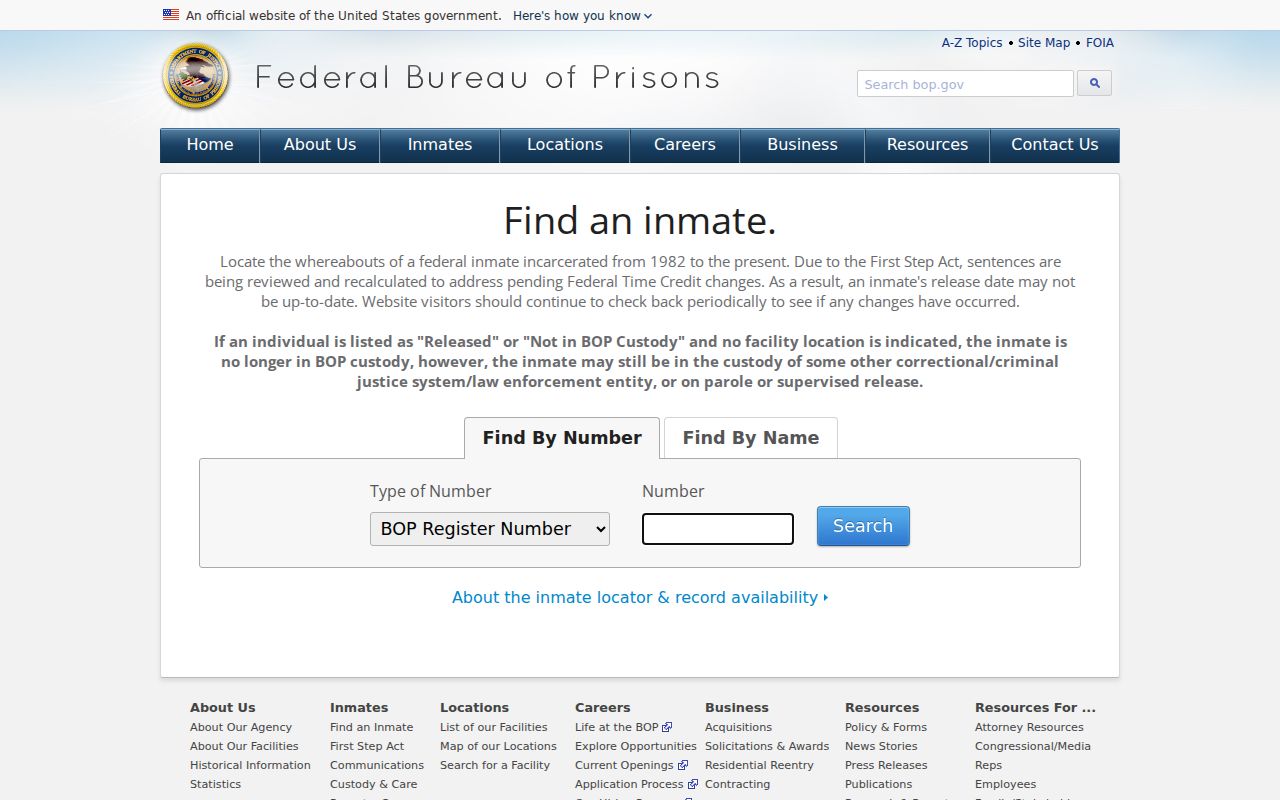
The source shown above is useful only after the correct custody level is known. A current locator result is not the court file, and movement or release can make a saved result stale.
Compare Maryland Search Channels
Official indexes name the custodian, display stable identifiers, and provide a copy route. Commercial compilations may combine sources, but they can be stale, merge two people, omit context, or hide details behind a charge. Verify any lead against the official Maryland record. Free online access also does not mean each image or certified copy is free.
| Channel | Best use | Check |
|---|---|---|
| Official index | Find a case, parcel, deed, estate, or license | Identifier and jurisdiction |
| Clerk counter | Inspect the full public file | Rules and copy fee |
| Mail or form | Request a named record | Eligibility and ID |
| Library or Archives | Reach older series | Dates and series number |
| Commercial compilation | Generate a lawful personal lead | Every fact at its source |
Maryland Archives Extend the Search
Maryland's record trail reaches back to the colony's 1634 founding, but it is not one unbroken database. The State Archives Guide describes land, probate, vital, naturalization, military, court, and local series by jurisdiction and date. Some images are online. Others require an order, search-room visit, or staff retrieval. Save the county, series title and number, box, accession, and liber/folio.
For family history, combine Archives series with Enoch Pratt Library, Digital Maryland, church registers, newspapers, cemeteries, census schedules, and city directories. Printed directories can give a working adult's name, work, and address, but they omit many women, children, boarders, rural residents, and marginalized residents. Absence is weak evidence.
Maryland's Legacy of Slavery project adds freedom certificates, manumissions, and related sources. When surnames shift or disappear, search a first name with county, enslaver, estate, plantation, or place.
County creation dates matter in a historical Maryland search. A deed, probate file, or court paper may belong to the parent county that existed when it was made. City directories and census wards can also make a household seem to move when only a boundary, ward, street name, or street number changed. Baltimore's 1918 renaming and renumbering work is a clear case. Compare the old address with maps and directory volumes instead of forcing it into a modern parcel search.
Maryland Portal Changes Reward Citations
The fall 2025 MDLandRec replacement required new credentials and two-factor authentication and changed remote access. In March 2026, the Judiciary launched a combined Case Search and Record Portal after an earlier conversion delay. These changes show why a result URL is less durable than a case number, estate number, parcel account, Department ID, license number, or liber and folio.
Record the identifier, jurisdiction, date searched, and office holding the file. If a portal changes, take those facts to the clerk, Register of Wills, assessment office, board, library, or Archives. For open records not published online, Maryland agencies may accept a focused request by email, web portal, mail, or in person. Special rules still control courts, voters, motor vehicles, and vital records.
A focused request names the record, subject, office, date range, and desired format. Maryland's Public Information Act generally reaches existing agency records, not research or a new custom report. A request also cannot override the special restrictions governing a certificate, voter list, sealed case, or protected motor-vehicle data. If the office is wrong, use the statewide directory to identify the actual custodian before resubmitting.
That habit turns a Maryland people search into a checkable trail. It helps staff distinguish a dead link from a missing file, archived volume, wrong jurisdiction, or protected record.